Showing posts sorted by date for query apps. Sort by relevance Show all posts

5 Big New Ways Facebook Laid The Groundwork For Making Money During Q3 2012


You probably won’t see the revenue bump in Facebook’s earnings report today from all its new monetization schemes. But with this quarter’s rollout of Gifts, a mobile ad network, app install ads, FBX, and Sponsored Results, Facebook tried show the world that it has new engines to power profits. Earnings and share price may drag for a while longer, but here’s how they have the potential to kick into high gear eventually.
Facebook VP of corporate development Vaughn Smith said at a conference last week, “It’s funny to reflect back that in the first quarter of this year we had no ads on our mobile product.” Wall Street sure didn’t get the joke. Facebook’s user base is shifting to the small screen, and investors were right to worry the social network might not have a way to squeeze dollars from them there. That’s partly why its share price has stumbled to $19.32 down from $38 where $FB IPO’d.
So Facebook has been pushing itself through a transformation to become a company that thinks mobile first. From a product development standpoint, that shift has been rapid. A year ago it was designing for the web and then porting those designs to mobile. Now Facebook spec’s out products with mobile as the priority. Most teams ship their own mobile code too, instead of relying on a specific “mobile” team like it did last year.
But transforming into a mobile money-maker takes longer and Facebook still has to prove it’s possible. When it builds new commerce channels, it has to raise awareness and then get people actually opening their wallets. When it offers new ways to advertise, it must demonstrate to businesses that the ads deliver return on investment, and then recruit big spenders to buy them. It could take several quarters for the bump from new monetization schemes to appear in the bottom line if they even work.
Facebook’s existing mobile ad formats are performing well and all the ads tech companies saybusinesses are eager to buy them. But Facebook needs whole new ways to make money if it’s going to get to a more reasonable price-to-earnings ratio.
So let’s take a look at the five big revenue drivers Facebook announced or implemented this quarter, and how close they are to actually giving it a revenue boost:

FACEBOOK GIFTS
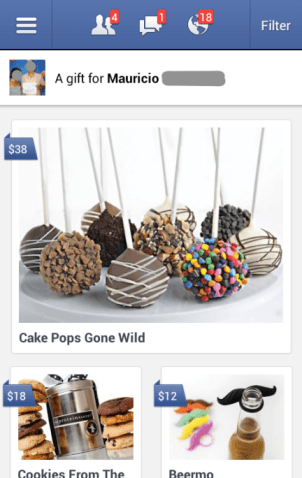
Launched September 27th, Facebook Gifts is the company’s big entrance into ecommerce that lets users buy presents for friends when it’s their birthday, wedding, engagement, graduation, other special occasion, or just whenever. Users see alerts about these special occasions and a chance to buy Gifts on the top right of the desktop homepage and at the top of the mobile news feed. The gifts range from digital gift cards to physical shipments of flowers, chocolate or toys that Facebook sources from and has delivered by its partners. Facebook earns an undisclosed, varying revenue cut on each gift sold.
Facebook Gifts has big potential because it knows who people are likely to buy gifts for better than anyone else. Whose statuses we like, who we have the most friends in common with, who our family members are, and who we’re tagged in photos with all factor into its affinity rankings. Many people visit daily and spend lots of time on Facebook, so there are plenty of opportunities to get them to purchase.’
Facebook also built the shopping experience around convenience, using profile data to suggest what people should buy friends. Young dude? It’ll say to buy him Bourbon-barrel aged maple syrup. Middle aged woman? A Starbucks card or box of chocolate might be the top recommendations. It could get people to buy gifts when they otherwise might just say “happy birthday”, and could pull dollars away from Amazon, gift card providers, flower delivery services, and brick-and-mortar stores.
Unfortunately, even if a reasonable percentage of US users bought a few Gifts a year, the margins may not be big enough to seriously move the needle. There’s also no international roll out in sight. In any case, that would definitely complicate shipping and many markets don’t have the disposable income to buy Gifts. Facebook may need to find a way to convince people in its key markets to buy as often as once every two months for Gifts.
Status: Gifts is still being slowly rolled out to U.S. users. By the end of next quarter it should have reached most of the U.S. and we may hear if people are actually buying Gifts.

MOBILE AD NETWORK

Announced September 18th, Facebook’s mobile ad network allows advertisers to pay it to improve the targeting of ads they buy within non-Facebook mobile apps and sites. It solves a major problem for both ad buyers and sellers — namely that ads are often inaccurately targeted. That means a buyer’s message doesn’t reach the right audience and they don’t get clicks. Meanwhile, ad hosts like apps and website can’t charge advertisers for clicks and the irrelevant content worsens the experience for their users.
While traditional ad networks make educated guesses about who their visitors are, Facebook knows a ton about its users because they volunteer their data. With Facebook’s bio, social, and app usage data, this new mobile ad network lets marketing messages be pinpointed to appear to 30-year-old engaged women, 26-year-old guys who Like surfing and live in Los Angeles, or 22-year-old recent Harvard alumni who use apps similar to one made by an advertiser.
The mobile ad network is huge for Facebook because it earns the company more money without forcing it put more ads or commerce options in its own apps. That lets it maintain the quality of its user experience, and avoid drowning out organic social content with paid ads. As the Internet is increasingly accessed through apps that need ways to monetize, Facebook could earn a lot of money by getting them to host its ads.
Status: Facebook’s still calling this a test, and only a few trusted partners can use it. Facebook hasn’t released details of the ad network’s partners, design, or performance, and it is unlikely to have produced noticeable revenue yet. But mobile ad spend nearly doubled this year, and Facebook could rollout expand the similar ad network for the web that it’s testing on Zynga.com. By next quarter there should studies available on its performance. It should also be accessible to more advertisers and visible on more apps. In 6 months we’ll see if it’s gained traction.

APP INSTALL ADS

Announced on August 7th, app install ads allow developers to pay to inject “Install Now” ads into the mobile news feed. They show their app’s name, icon, description, Facebook App Center rating, and friends who use them. When clicked they lead straight to the App Store or Google Play market where users can download the apps.
If the mobile web is all about apps, Facebook wants to be the way developers pay to get people to discover and install them. There’s already a huge industry around paid app discovery that Facebook is vying for a cut of. It could succeed by leveraging the amount of time users spend browsing its mobile apps and the knowledge of which apps their friends use.

Mobile app install ads are also Facebook’s first serious foray into showing non-social ads in the news feed, which includes some risk.. Friends don’t have to have Liked a developer or used an app for ads promoting it to show up in someones feed. As showing too many of these pure ads could drive users way, the revenue Facebook could earn on them is constrained.
Status: Last week all developers gained the ability to buy app install ads. Expect studies on their performance to arrive soon and Facebook to highlight the money they’re generating in its Q4 earnings.

FACEBOOK EXCHANGE

Though it was revealed late in the previous quarter on June 13th, we didn’t hear the first results from the Facebook Exchange (FBX) cookie-based retargeted ads program until late August. FBX lets advertisers target their ads on Facebook to users who’ve recently visited specific websites. For example a travel company could target users who viewed but didn’t buy a flight to Hawaii with ads promoting that same flight.
The early rumors said they were working very well, and by September Facebook permitted the demand-side platforms that buy the ads to share performance results, which were extremely promising. For some advertisers, each dollar they spent on FBX ads brought in $16 in sales. And I’ve heard that while DSPs are still learning how to use FBX, they are getting as good of results from it as they get from Google’s retargeted ads that they’ve been buying and optimizing for years.
FBX lets Facebook break into the realm of advertising to people with purchase intent, similar to search ads. Because the return on investment can be linked more directly to ad spend, advertisers may be willing to pay more for FBX ads than the traditional brand advertising seen on Facebook. Many advertisers have specific budgets for retargeted ads that Facebook can now tap into. If it can provide conclusive evidence that FBX works better than Google’s ad exchange, massive spend could pour in.
Status: Over a dozen DSP partners can now buy FBX ads, initial results are strong, and more advertisers are getting excited about the program. They’ll still need time to learn how to master the ad format, but we may see notable revenue from the product on the earnings call. By next quarter spend should ramp up and FBX could become a significant part of Facebook’s business.

SPONSORED RESULTS

Facebook doesn’t have a full-fledged web search engine yet, but on August 22nd it officially launched its Sponsored Results ads for the site’s search typeahead. These let businesses pay to have their Page, app, or other Facebook property appear above organic results when users search for a specific property. For example, gaming company Playdom currently pays to show its game Marvel: Avengers Alliance at the top of typeahead results when people search for “Mafia Wars”, a game by its competitor Zynga.
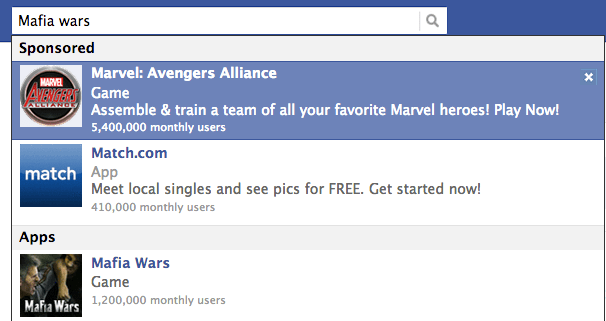
Initially announced in the previous quarter, these last few months saw the rollout of the API for buying Sponsored Results, and the first reports of the performance. Optimal attained click through rates between 0.7% and 4.1%, well over 10x better than standard Facebook sidebar ads. Meanwhile Nanigans saw CTR exceed 3% in some campaigns, and found the ads could cost less than standard ads.
Sponsored Results are a powerful way for businesses to divert traffic to themselves and away from competitors, making them a lucrative buy in cut-throat industries. Their performance and advertiser interest bodes well for the money-making potential of a real Facebook web search engine — something CEO Mark Zuckerberg said is in the works and investors are salivating over. But for now, there may not be enough people searching in the typeahead for these to be hugely profitable.
Status: Sponsored Results can now be purchased through the Ads API and Power Editor, and are now appearing in the typeahead results of search for many popular apps and Pages. They may have already generated a little revenue, which could grow next quarter. More important, though, is how they foreshadowing a serious Facebook search ads business — a completely new monetization channel.

IT’S GONNA GET WORSE BEFORE IT GETS BETTER

Until these products gain traction, Facebook’s earnings may not be too impressive. And next month, nearly 1.2 billion additional shares will become eligible for sale by employees and investors when a big part of the company’s stock lock-up expires on November 16th. That means the share price is likely to dip lower.
$FB may rise again once this major post-lockup flood subsides and these new money-makers kick in, but at least until then Facebook will need to sell Wall Street on the future, not the present. It has to communicate that the evolution of advertising and commerce depend on the data only Facebook has.

Enhanced by Zemanta
Tags: Facebook, Starbucks, Wall Street, FBX, Facebook Gifts, Facebook features, Mobile code, Mobile payment

3 Hot Tech Startups Burning Up L.A.'s 'Silicon Beach'


Silicon Valley may be America's most famous nebula of tech startup stars, but it's getting some serious competition a short hop down California's coastline.
With a robust system of incubators and accelerators producing a flurry of new companies -- more than 1,400, according to the AngelList startup community-- Los Angeles is looking to make a name for itself as a prime destination for putting down business roots.
Better weather, more affordable rent and proximity to the entertainment industry are just a few of the factors driving the L.A. startup scene's growth. Many of the ventures in what's been called "Silicon Beach" are tapping into the power of celebrity users and investors to drive awareness.
We spoke with the founders of three hot startups in the area about their success and key lessons they have learned piloting their ventures.
3 Hot Tech Startups Burning Up LAs Silicon Beach
Viddy's Brett O'Brien, Chris Ovitz, and JJ Aguhob
image courtesy of the company
Company: Viddy
Product: iPhone app for sharing 15-second video clips with effects
Founders: Brett O'Brien, JJ Aguhob, Chris Ovitz
Launched: April 2011
What began as an iPhone app for sharing short user-generated video clips has grown into a community of 40 million users. An array of celebrity devotees have signed up for or endorsed Viddy including Jay-Z, Justin Bieber, Will Smith, Mark Zuckerberg and Twitter co-founder Biz Stone.
"Fifteen-second Viddys are the '140 characters' of video for people in Hollywood who create, share and consume with an online community," says Viddy co-founder JJ Aguhob.
Viddy has raised $36 million so far in two rounds of funding, from investors including Battery Ventures, Greycroft Ventures, Qualcomm and Jay-Z's Roc Nation. The company's major competitor, Socialcam, was acquired by 3-D design software company Autodesk in July.
The founders say their focus is on attracting more users and improving the product. Strategies for generating revenue -- such as in-app purchases for premium video effects, celebrity-sponsored add-ons, cloud storage and uploads of longer videos -- are still being worked out.
Startup lesson: Put users first. 
"To build a business organically, it 110 percent starts with the product and an experience that people can care about and easily engage with," says co-founder Brett O'Brien. "If you treat your venture as your passion, others will take notice and be drawn to your work." 
 
3 Hot Tech Startups Burning Up LAs Silicon Beach
Instacanv.as founders Matt Munson, Todd Emaus, Steve Bull and Kevin Fremon
image courtesy of the company
Company: Instacanv.as
Product: Allows Instagram users to sell their photos as physical canvas art
Founders: Matt Munson, Todd Emaus, Steve Bull, Kevin Fremon
Launched: February 2012
Facebook's $1 billion purchase of Instagram has excited more than just that company's options holders. Other startups see the photo-filter and sharing app as a new platform worth building an ecosystem around.
In the case of Instacanv.as, its four founders saw an opportunity to turn pictures taken with Instagram into real artwork. Instagram "artists" can easily set up an online gallery enabling sales of their creative phone photos as physical media. Products include traditional canvases, framed prints, and a unique one-inch thick acrylic glass product dubbed The Prism.
A short six months from launch, the site is powering galleries for more than 100,000 photographers in more than 30 countries, says co-founder and CEO Matt Munson.
The product began as an online education site, operating solely on seed money. The team quickly changed course, based on the founders' interest in Instagram and their desire to buy their own prints. Instacanv.as suddenly grew "way faster and more wildly than we ever anticipated," Munson says.
A graduate of L.A. accelerator MuckerLab, Instacanv.as has raised nearly $2 million from several groups, including FF Angel, First Round Capital and Bullpen Capital. The company says it has been exceeding a $1 million annual revenue rate since launch.
Startup lesson: Iterate quickly. 
The Instacanv.as founders stick to the lean startup methodology of Eric Riess and to testing and learning on the fly. "If something's not working, try iterating very quickly to find something that does work," Munson says.
 
3 Hot Tech Startups Burning Up LAs Silicon Beach
Norm Schifman and James Citron, founders of Mogreet
image courtesy of the company
Company: Mogreet
Product: A mobile text and video messaging platform for marketers
Founders: Norm Schifman, James Citron
Launched: August 2006
Based in Venice, Calif., Mogreet began as a mobile greeting card delivery service. The company eventually pivoted, turning its mobile media platform into a tool for marketers to deliver text and multimedia message campaigns. The company now licenses its mobile marketing services to Fortune 500 companies.
Over the past two years, the company's mobile video messaging volume has grown by 400 percent, and Mogreet expects to increase revenue by the same amount in 2013, "as consumer brands, advertisers and mobile developers look to the mobile phone as the primary screen to engage with their audience," says CEO and co-founder James Citron. The company is profitable, with revenue coming from annual brand contracts in the range of $50,000 to $500,000, monthly messaging fees and third-party developer adoption.
With total venture capital of $14.1 million, Mogreet is supported in more than 175 countries and reaches two billion consumers. Most recently, the company launched an API service that gives developers a way of delivering text and multimedia messages, in-app messaging and more in their own apps.
Startup lesson: Don't be afraid to expose your idea.
Listen to the opinions of friends, customers and others, "and use them to create breakthrough products to evolve your ideas and, ultimately, build great companies," Citron says. "Ideas are a dime a dozen. Execution is everything."

Enhanced by Zemanta
Tags: Startups, Silicon Valley, iPhone, Los Angeles, AngelList, Justin Bieber, Jay-Z, Biz Stone, Roc Nation

12 Cloud Apps To Make Your Business More Productive


Sick and tired of hearing me bleat on about my favourite apps and services? Sit back and read this guest post originally published back in 2010 by James Adams who outlines his personal choices.
Cloud computing is the latest in the trend to minimize IT costs and increase productivity. Software from the cloud takes the burden of administration off of the local organization, relieving much of the demand for in-house expertise. Cloud based represents higher productivity for in-house and mobile workforces in the form of accessible and secure computing with more up time. Here are 12 cloud apps that will make your business more productive.
1-basecampAn online project management tool that runs through the cloud and provides team collaboration features. Everything you need to manage your projects is found in Basecamp, including file sharing, scheduling, task management and assignment, and feedback. Basecamp interacts with several iPhone apps, and third party computer-based tools to give you maximum accessibility and flexibility wherever you are. Packages available range from 15 projects to unlimited. A 30 day trial lets you see if Basecamp will fit the needs of your business before you buy.
2-dropboxA web-based file sharing service that also provides secure file storage, synchronization, and backup. Files can be accessed from anywhere and changes made to files by the team are automatically synced to user’s local computers. Supports Linux, Mac, and Windows. Dropbox offers 2 GB of storage free so you can see how it works prior to purchasing.
3-zohoA cloud based office software suite, offering powerful document creation management tools for spreadsheets, word processing, invoicing, CRM, and more. You pay for only the apps you use.


4-dimdimWeb conferencing software that resides in the cloud and offers a great medium in which you can interface with your mobile workers, customers, and vendors. Rather than having people travel to meetings, why not let everyone stay home, save the earth and attend the meeting online?

5-pixlrCloud-based image editing services. Three applications, Editor, Express, and Grabber combine to give users amazing power to create and edit images.


6-githubSocial coding application that runs through the cloud to provide version control and collaborative software development. Several packages are available from the free open source plan to the Giga plan that includes 300 private repositories, private collaborators, and 60 GB of storage. There is also an enterprise version of Github that companies can deploy on their own cloud platform.

7-freshbooksA financial management application that’s hosted in the cloud. This program offers “painless billing” that makes it easy to bill clients, track payments, and perform other bookkeeping. This app is specially designed for teams, freelance workers, and service providers.

8-google-docs
A personal repository of documents that can be shared and updated as needed. Google Docs features revision tracking and allows users to save documents locally if necessary. This application is free.

9-mojo-helpdeskProvides online customer relationship management (CRM), including request tracking, ticket assignment, email integration, and on demand help. Eleven users are supported for the $24 monthly fee, with an unlimited option available for $49.

10-cloudmark-desktopBusiness with real time protection from email spam, phishing, and viruses without loading down the computers on your network.


11-appointyAn online scheduling software that provides businesses with appointment and schedule management. The software can be configured to allow customers to make their own appointments and send out text and voice alerts for appointments. Appointy even has tools available to promote your business. Practically any business that schedules appointments over the telephone will appreciate the power Appointy offers to make businesses more efficient and productive.

12-gliffyProvides cloud-based charting and diagramming. This powerful app gives business access to the tools needed to create professional flow charts, floor plans, and technical drawings.
Cloud based applications are perfect for managing business functions from any web browser so employees and managers can be productive wherever they are. With software management and administration performed by the host, businesses can focus on their mission rather than on IT related tasks. Try these applications out and see how powerful web-based applications can transform your business.
This guest post was written by James Adams who is a blogger working for an online storeoffering toner next day for the UK. He is a contributor to their design blog where he posts about technology and design.
Tags: Basecamp, Cloud computing, Project management, Linux, Web conferencing, Office suite, iPhone, Windows

Enhanced by Zemanta

5 Big Data News You Should Know Today - 22 October 2012


1) Why VCs Will Continue To Invest In Big Data Startups For Many Years To Come

This week, Splice Machine raised $4 million to develop its SQL Engine for big data apps. MongoHQ raised $6 million for its database as a service. A third startup, Bloomreach, announced $25 million in funding for its big data applications.

These three companies provide examples for why the investor community will continue to invest in big data startups for many years to come. All reflect a changing dynamic — the rise of the big data app and the need for a new data infrastructure. These two converging trends now drive funding for a widening number of startups that make data functional inside and outside the enterprise.

Read More


2) Gartner, IBM See Big Market for Big Data

Big data is becoming big business, and is a big trending topic in 2012.  This week Gartner and IBM release reports studying the true impact and direction of the big data market, while Teradata launched a big data analytics appliance.

Gartner says big data to reach $34 billion.  As a prelude to the Gartner Symposium/ITxpo 2012 it reported that big data will drive $28 billion of worldwide IT spending in 2012, and is forecast to drive $34 billion in 2013 spending.

Read More


3) Will Big Data decide the election?

FORTUNE -- There's a powerful vignette in Sasha Issenberg's The Victory Lab in which political consultant Alexander Gage presents his new data targeting system to Mitt Romney's 2002 gubernatorial campaign.

Gage has combined consumer records with political voting history to identify potential Romney supporters among nontraditional Republican voting blocks. Gage sees his work as revolutionary -- a first in politics, and potentially a first anywhere. Yet just as he completes his presentation, Romney's deputy campaign manager Alex Dunn raises his hand and deadpans, "You mean you don't do this in politics."

Read More


4) Is More Big Data a Blessing or a Curse for These Giants?

In today's segment, Fool.com analyst Austin Smith interviews acclaimed author and New York Times columnist Charles Duhigg about his recent book The Power of Habit and the iEconomy series he's written for the Times.

Today, Charles looks at whether more big data will help or hurt the companies that have already mastered the art of studying consumer spending habits. Companies such as Wal-Mart and Target have had an edge over other retailers for years with their mountains of data, but with Big Data overflowing now, will that advantage evaporate?

Read More


5) Sharing data a big complicated step for health care system

To those in fully automated industries, like banking, the state's rollout of a new health information network last week must seem sadly behind the times.

Massachusetts officials declared the Health Information Exchange open for business Tuesday by sending Gov. Deval Patrick's medical data from a hospital in Boston to a trauma center in Springfield. The electronic information traveled halfway across the state and, just as importantly, crossed tricky medical provider boundaries.

Read More

Category: Big Data News

Tags: Technology,Business,Big data,big data market,big data apps,big data applications,big data startups,Big Data,Read,new data infrastructure,Gartner,big data analytics appliance,Big Data News,three companies,big trending topic,big complicated step,hand,Wal-Mart,business,new health information network,Target

10 Ways to Trim Shipping Costs


10 Ways to Trim Shipping Costs
Shipping costs are one of the biggest expenses for many small businesses, but resourceful entrepreneurs are finding ways to reduce the sting.
Fred DuBois, for example, had been trying to cut theshipping costs at his Laptop Battery Express in Cleveland since he founded it in 2007. Free delivery service for about 50 battery orders a day was costing him as much as $500. He had been relying almost exclusively on FedEx Ground, but this summer, he realized that varying his carriers and using the U.S. Postal Service would cut shipping costs in half. Today, he says, he ships about half his orders with FedEx and the other half with the post office, saving about $250 a day.
To achieve such savings, consider these 10 ways to trim shipping costs:
1. Negotiate with multiple carriers. All shipping companies have pricing schedules based on volume: The more you ship, the lower your rate. But small businesses often don't realize they also may have negotiating power, says Jack Mitchell, president of PANCGroup, a Boston-based parcel appraisal and negotiations consulting firm. If you ship large numbers of packages, compare prices and try to persuade carriers to offer lower rates. "If Fed Ex knows UPS is vying for your business, you've got something to negotiate," Mitchell says.
2. Get suppliers to use your shipping account number. DuBois receives inventory from 12 suppliers, including eight in China and four in the U.S. While he originally had suppliers shipping products to him and invoicing for the transport costs, he managed to persuade his domestic suppliers to ship products on his company's FedEx account number. This not only increases his business's shipping volume, which can lead to cheaper rates, but it also helps prevent suppliers from padding their shipping costs. Kevin Lathrop, president of Unishippers, a Salt Lake City-based company that buys and resells transportation services, recommends including this shipping requirement in your purchase order.
3. Use packaging provided by your carrier. If you use your own packaging, you could face additional "dimensional fees" if your box exceeds the size regulations set by UPS and FedEx. To avoid those extra charges, consider using the packaging provided by your carrier, which doesn't have dimensional fees. By putting a one-pound box into a FedEx envelope, for example, DuBois cut his shipping cost by 15 percent.
4. Consider a regional carrier. Such carriers often provide the same services as FedEx or UPS at a reduced cost, Mitchell says. Regional carriers include Spee-Dee Delivery Service in the Midwest, OnTrac in the West and LoneStar Delivery & Process in Texas. But keep in mind their delivery networks are limited. You also might reduce your bargaining power if you spread your business among too many carriers.
5. Use online shipping. One way to save on U.S. Postal Service costs is to pay for your shipping online. You can save up to 16 percent on priority mail orders and up to 60 percent on express mail, says Beth Fluto, manager of digital media for USPS. You also get free pick-up service, priority mail delivery confirmation and shipping supplies when you pay online with the post office.
6. Invest in prepaid shipping. To help cut FedEx and UPS costs, consider prepaid shipping, which offers a discount rate of up to 20 percent. This means you buy a quantity of shipping labels upfront and affix them to packages as needed rather than pay for each package when you send it out. Prepaid shipping works best when you know you'll be sending out the same weight packages repeatedly and can determine the shipping cost in advance.
7. Buy insurance from a third party. While carriers charge about 80 cents for every $100 of insurance, third-party companies like Parcel Insurance Plan and U-PIC Shipping Insurance charge about 45 cents. The savings can add up, Mitchell notes, if you frequently ship expensive items.
8. Factor in all shipping fees before billing customers. Carriers have more than 75 special charges, including fuel surcharges, fees when requiring a signature from the recipient, or Saturday delivery fees, Mitchell says. If your customers pay for shipping, be sure to include all these extra costs in their bills so you don't end up absorbing them yourself.
9. Consider hybrid services. While they have certain volume, weight and size restrictions, hybrid services like SurePost by UPS and SmartPost by FedEx can cost half as much as standard UPS and FedEx delivery options, Mitchell says. These services pick up packages at your business and ship them by UPS or FedEx to the post office closest to the destination. The local mailman then makes the final delivery. While the cost is less, this extra step can slow delivery time.
10. Ask about association discounts. Find out if your industry's professional association has a partnership with a carrier that offers member discounts. Depending on the size of the association, you could be eligible for discounted rates of up to 50 percent on certain services with carriers like FedEx and UPS.

Enhanced by Zemanta
Tags: FedEx, United Parcel Service, OnTrac, Salt Lake City, United States Postal Service, U.S. Postal Service, Package delivery, Mitchell

4 most ridiculous technology patents ever granted?


Here are a few of them:

1. Amazon's one-click patent

When you shop online, you know how you can save your shipping address, credit card details etc so that you don't have to type it again for your next purchase? Your subsequent purchases can thus be done with a single click- and Amazon owns the patent for this. They even sued Barnes & Noble for having this feature in their site.

Reference: http://en.wikipedia.org/wiki/1-C...


2. Pull to refresh
Image representing Twitter as depicted in Crun...
Image via CrunchBase


The pull to refresh feature present in many apps is actually patented by Twitter, which was the first to come out with this feature.

Reference: 
http://dcurt.is/pull-to-refresh


3. Making links in email clickable

English: Wordmark of HTC. Trademarked by HTC.


All links and phone numbers in emails can be made clickable, even when the original email sent by the user didn't make them clickable links. Sounds trivial right? But implementing this can get you sued by Apple (it has already sued HTC over this patent).


The patent details here: http://www.google.com/patents/ab...


4. Buying stuff inside an app

Yes. This is patented. Even if an app says "Click to here to buy the full version", they are "infringing a patent". Hell, Rovio(maker of Angry Birds) got sued over this by Lodsys which owns the patent.

Reference: http://venturebeat.com/2011/07/2...

This is a list of patent infringements that Apple is suing HTC  over. A few of them seem ridiculous, you be your own judge:

http://www.engadget.com/2010/03/...


Tags: Apple, Patent, Lodsys, Lawsuit, Twitter, HTC Corporation, Rovio, Patent troll
Enhanced by Zemanta

10 Easy & Creative Ways That You Can Make A Million Dollars This Year


When they say there is a million and one different ways to make something work they aint wrong. If you really wanted to make millions and you have the time and patience to master the art of a new found passion of yours, you could be well and truly on your way to making you millions. iPhone Apps, Kindle Books, eBay stores and Twitter tweets are a just a few platforms out there that allow you to make serious doe.
Be resourceful like these guys here and you could be cashing in, in a new, fun and creative way.

Sell 714,286 Self-Published Books On A Kindle

Average cost of a book sold:$2
Profits you keep:70%
Million-dollar math: For every $2 book sold, you keep $1.40. $1.40 X 714,286 books = $1,000,000.40
Who did it: Earlier this year, 26-year old Amanda Hocking was the best-selling “indie” writer on the Kindle store. She was selling around 100,000 copies per month at $1 to $3 a pop which set her on track to pocket a few million dollars.

Sell 477,483 apps in the App Store

Average cost of an app:$2.26, but since Apple doesn’t let people sell apps for that amountwell round up to $2.99.
Profits you keep: 70%
Million-dollar math: For every $2.99 app sold, you keep $2.093. $2.093 X 477,784 apps = $1,000,001.91
Who did it: Doodle Jump’s Igor and Marko Pusenjak, Tap Tap Revenge and Peter Verterbacka of Rovio’s Angry Birds

Rent your car for 8,680 days (208,334 hours) on GetAround

What it is:GetAroundlets you rent your car to strangers for an hourly rate of your choosing. GetAround covers all insurance and other costs of operating the service, and renters are responsible for the gas they use.There are no expenses beyond GetAround’s 40% commission.
Average cost per hour: $8.00 per hour.
Profits you keep: 60%
Million-dollar math: For every hour, you keep $4.80. $4.80 X 208,334 hours = $1,000,003.20
Who did it: No one yet. Be the first.

Teach 5,082 Skillshare classes

What it is: Skillsharelets anyone teach a class on anything they’re good at.  Teachers set the cost of the ticket, find a venue, and pick a day to host a class on a topic of their choosing. Skillshare takes 15% of all tickets sold and PayPal takes 3%.
Average cost per ticket: Tickets range from free to hundreds of dollars. According to a third-party source, the average ticket cost is $24 dollars. Classes have about 10 people in them.  Teachers keep all cash aside from paying Skillshare 15% of the revenue and PayPal 3%, so they make around $196.80 per class.
Profits you keep: 82%
Million-dollar math: $196.80 X  5,082 classes = $1,000,137.60
Who did it: No one yet. Be the first.

Sell yourself 250,000 ways on Fiverr

What it is: Sell anything you can think of for $5 on Fiver. “Gigs” include “I will get you at least 800 Twitter followers within 7 days for $5″ and “I will create a video of you producing a fireball using your own hand for $5″
Average cost per gig: Everything costs $5.
Profits you keep: 80%
Million-dollar math: For every $5 gig sold, you keep $4. $4 X 250,000* gigs = $1,000,000
Who did it: No one yet. Have a go at it.

Sell 10,262 business plans on eBay

Cost per business plan:$111 (£68.00)
Profits you keep:eBay charges a $0.50 insertion fee, 15.0% of the initial $50.00, plus 5.0% of the remaining final sale price balance which leaves you with $97.45 per business plan sold.
Million-dollar math: $97.45 X 10,262 business plans = $1,000,031.90
Who did it: Earlier this year, Samuel Katabaaz tried to sell 99,999 copies of his startup’s business plan for £68.00 each. The idea was to fund his startup without giving up any of the equity. It’s not clear how many items he actually sold.

Tweet 800,000 sponsored messages on MyLikes

What it is:Tweet out sponsored messages and get paid a few cents every time one of your followers clicks on the ad.
Average cost per click: Cost per click is different for every user based on a calculated MyLikes Engagement Score. The score is determined by the user’s activity on Twitter, Facebook and YouTube. Over time, the score changes based on how many clicks the user generates per sponsored tweet.MyLikes tells us for a person with a few thousand followers, the average earning per click is between $0.10-$0.25. If you have 100,000+ followers, you can earn up to $1 per click.
For the sake of this scenario, we’ll put the average CPC at $0.25.
Profits you keep: 100%
Million-dollar math: $0.25 X 4,000,000 clicks = $1,000,000. If 5 people click every sponsored tweet, you’re looking at 800,000 tweets.
Who did it: Some of MyLikes’ celebrity tweeters, like Snooki and Khloe Kardashian, have made $40,000 per month on MyLikes. At that rate, it wouldn’t take long to hit $1 million.

Complete 3,225,807 HITS on Mechanical Turk

What it is: Sign up to do freelance workat costs often below minimum wage.
Average cost per gig: In 2009, NYU professor Panagiotis Ipeirotis tracked all MTurk HITS (Human Intelligence Tasks) for two months and found the average value of HITS posted per day was $2,000. Most people, he estimated, use the site one day per week and earn about $20.
But most of the recent HITS we found only pay a few cents per completed task. Businessweek tried out the service for seven hours one day, completing about 15 jobs, and making just $0.63 per hour. That comes out to $0.31 cents per HIT. We’ll use $0.31 cents/HIT for our calculation.
Profits you keep: 90% — Amazon takes 10% commission of every final HIT payment with a minimum fee of half a cent.
Million-dollar math: $0.31 X 3,225,807 HITS = $1,000,000.17
Who did it: We hope no one. It sounds grueling.

Rent your apartment for 10,520 nights

What it is: Rent a room in your apartment to a stranger for an amount and length of your choosing.
Average cost per rental: Hosts can charge renters whatever rate they want per night. Costs depend a lot on the host’s location though. AirBNB has a rate recommendation widget based on the host’s location.
When we typed in “Private Bedroom in NYC” it recommended we charge $98 per night. Even though NYC rates are higher than many other cities, we’ll use the $98 estimate for our calculation.
Profits you keep: 97% of the total rent cost.
Million-dollar math: For every $98/night rental, you keep $95.06. $95.06 X 10,520 nights = $1,000,031.20
Who did it: If no one has done it yet, a few AirBNB users are well on their way. Daren from London says he has made $100,000 via AirBNB. Jeff from Paris says he’s made $90,000.
Cofounder Brian Chesky also decided to go homeless everyday for a few months, so he probably made some good money using his service during that time.

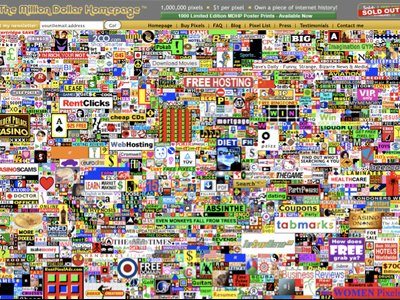
Sell 1,000,000 pixels on a webpage to advertisers

Cost per pixel:$1
Profits you keep:100%
Million-dollar math: $1 X 1,000,000 pixels = $1,000,000
Who did it: 21-year-old Alex Tew.
Article By BusinessInsider.com
Tags: IPhone, Twitter, App Store, Amazon Kindle, Apple, GetAround, eBay, Amanda Hocking

Enhanced by Zemanta