Showing posts sorted by date for query big data. Sort by relevance Show all posts

5 Big Data News You Should Know Today - 24 October 2012

1) Using Big Data to Save Lives

Computer scientists and a doctor are working to mine data from pediatric intensive care units to help doctors treat children and cut health care costs

“This data has the potential to be a gold mine of useful – literally life saving – information,” said Keogh, who specializes in data mining, which involves searching for patterns and irregularities in large data sets.

He is working with: Dr. Randall Wetzel, of Children’s Hospital Los Angeles; Walid Najjar and Vasilis Tsotras, both computer science professors at UC Riverside; and David Kale, one of Keogh’s graduate students.

Read More


2) A Khosla-backed big data energy startup you should know about

Are big data, analytics, and machine learning the answers to reducing the energy consumption of our homes? Yep, according to newly-emerged startup Bidgely that’s backed by Khosla Ventures. In an exclusive interview, Bidgely’s CEO gives GigaOM the details about what it’s been up to.

Read More


3) SAP's Creepy New Retail Software Uses Big Data To Make You Buy More Stuff

Not so long ago, the most advanced piece of technology present at the intersection of consumer and retailer was the cash register. Today, buyers are bringing their own technology on their shopping trips - and trailing a very revealing online data footprint. One big enterprise software company is promising retailers new technology that will let retailers leverage that information to market to those consumers in real-time.

For retailers and tech companies that serve them, billions of dollars are up for grabs. If there were any doubts that there was real money to be made leveraging big data to create custom marketing pitches in real time, those doubts should be shattered by Tuesday's entrance of mega-software corporation SAP into the retail tech frenzy. The move is the equivalent of an elephant walking into a room of working mice and telling everyone, "I've got this."

Read More


4) Gartner: Big Data to Be Big Job Creator

At a conference today in Florida, Gartner Inc. (NYSE: IT) forecast that information technology (IT) spending in 2012 would rise 3.8% in 2013, from $3.6 trillion to $3.7 trillion. But the really big news is in big data. According to the company’s head of global research:

By 2015, 4.4 million IT jobs globally will be created to support big data, generating 1.9 million IT jobs in the United States. In addition, every big data-related role in the U.S. will create employment for three people outside of IT, so over the next four years a total of 6 million jobs in the U.S. will be generated by the information economy.

Read More


5) Big Data: Moving from strategy to tactics

Big Data, which comes into the enterprise unstructured and unorganized, first needs to be “prepped” so that it can be processed by a business analytics program. Here’s what you need to do.

Now that business analytics are here and enterprises are grappling with their own “big data,” it’s time to set some technical strategies in motion to harness these assets. Fortunately, solutions for the data center that can deliver both high performance computing (HPC) and big data analytics are becoming increasingly scalable and affordable–even for medium-sized businesses.

The main challenge initially is getting your big data ready for analytics computing. Big Data, which comes into the enterprise unstructured and unorganized, first needs to be “prepped” so that it is able to be processed by a business analytics program.  This is no small task, as “cleaning up” big data goes through several phases.

Read More


Category: Big Data News
Enhanced by Zemanta
Tags: Big Data, Gartner, United States, Information technology, Khosla Ventures, Florida, NYSE, $3.7 trillion


10 Top Products Of The Past 4 Decades


If you feel that the present tech world is rapidly changing, with addition of new iterations to the products every now and then, then think again. Like every trend has some beginning, the tech world had one too, and it was seeded around 45 years back.


These innovations changed the way we live and run our businesses, the way we thought, communicated, bond over, the real and virtual worlds, all changed-- incited a new era in human evolution all together.    


#10 Computers


The invention of computer itself is a big thing, but the show stealer was not PC, not main frame, not even Charles Babbage’s Difference Engine(1849) or Konrad Zuse’s electromechanical Z3(1942). It was the most groundbreaking computer- ENIAC (Electronic Numerical Integrator And Computer). The device was first electronic general-purpose computer, conceived and designed by John Mauchly and J. Presper Eckert of the University of Pennsylvania; unveiled on February 14, 1946. It was capable of being reprogrammed to solve a full range of computing problems, and was designed to calculate artillery firing tables for the United States Army's Ballistic Research Laboratory. Later other "automatic" computers followed it, relieving actual human calculations on paper, ranging from simple math to artillery trajectories.


Wang Laboratories, a computer company founded by Dr. An Wang and Dr. G. Y. Chu Wang in 1951.  The company’s first attempt at a word processor was the Wang 1200(1971). Harold Koplow had written the microcode to perform word processing functions instead of number crunching, breaking new ground between typewriters and mainframes. Later WordStar for TRS-80(1979) put word processing onto personal computers. Something which made fingers just type on, than scribing it on paper.


#8 Delete Key


This simple innovation helped us to correct our mistakes without much fuss. It also reduced need for WhiteOuts, erasers, OS reboots and aftermath apologies; just press and undo.


#7 UNIX


UNIX is a multitasking, multi-user computer operating system developed by a group of AT&T employees at Bell Labs in 1969. The OS simplified the execution of computer programs on machines, before which the program had to converted it to punch cards and give them to MIS, which was then fed to the mainframe.


The whole new world of product based software took the roots in IT industry, powering even those with law IT skills to write programs. The programs were line-of-business applications and large-scale ERP, CRM and SCP systems; which eventually moved to the cloud and took the form of Salesforce.com, Facebook and World of Warcraft.


#6 Local Area Network


ARCNET was the first widely available networking system for microcomputers. It was developed by principal development engineer John Murphy at Datapoint Corporation, provided first commercial LAN in 1977. It answered the people’s need to share files, printers and WAN connections at affordable prices, and with greater speeds.


The external acoustic-coupler modem (1965) is the first device which converted analog signals from ordinary phone to turn huge computers of the time into network interfaces with blazing 300bps. Though it was included in PC World’s “Ugliest Product in Tech History” list, it defiantly paved way for modern ultra fast internet.


#4 Mobile Phones


The mobile phones were active as early as 1983 when commercial cell networks debuted in. Though at that time mobile phones were not sleek to fit into pockets or have multimedia functions, instead are huge and confined to vehicles, nevertheless the purpose of talking on the go was achieved.


#3 America Online


Steve Case founded AOL (American Online) the commercial ISP, introduced millions of people to internet and chat-rooms; the new experience unveiled. In 1989 when speed in kbps was norm, AOL brought in broadband, and started new online era. AOL led to CompuServe, which led to Web, which led to social networks like Facebook.


#2 Apple Newton


Apple’s Newton was first personal digital assistant (or PDA). Debuted in 1992, it changed the way a user managed personal data, and defined how convenient computer automation should be, making available the data whenever we wanted, in a portable user friendly device.  


#1 Wi-Fi Home Router


Before the advent of Fastwed, an Italian ISP Wi-Fi in 2001, building networks with cable modems was too complex, and expensive. Now Wi-Fi has turned into a domestic necessity of households like a water heater or cooker.


And also,


The Web


Tim Berners-Lee invented HTTP, HTML, and the URL in 1991. It was something which changed forever the way the information was exchanged, led to World Wide Web era, something indispensible in today’s personal or business life.


Enhanced by Zemanta

5 Big New Ways Facebook Laid The Groundwork For Making Money During Q3 2012


You probably won’t see the revenue bump in Facebook’s earnings report today from all its new monetization schemes. But with this quarter’s rollout of Gifts, a mobile ad network, app install ads, FBX, and Sponsored Results, Facebook tried show the world that it has new engines to power profits. Earnings and share price may drag for a while longer, but here’s how they have the potential to kick into high gear eventually.
Facebook VP of corporate development Vaughn Smith said at a conference last week, “It’s funny to reflect back that in the first quarter of this year we had no ads on our mobile product.” Wall Street sure didn’t get the joke. Facebook’s user base is shifting to the small screen, and investors were right to worry the social network might not have a way to squeeze dollars from them there. That’s partly why its share price has stumbled to $19.32 down from $38 where $FB IPO’d.
So Facebook has been pushing itself through a transformation to become a company that thinks mobile first. From a product development standpoint, that shift has been rapid. A year ago it was designing for the web and then porting those designs to mobile. Now Facebook spec’s out products with mobile as the priority. Most teams ship their own mobile code too, instead of relying on a specific “mobile” team like it did last year.

But transforming into a mobile money-maker takes longer and Facebook still has to prove it’s possible. When it builds new commerce channels, it has to raise awareness and then get people actually opening their wallets. When it offers new ways to advertise, it must demonstrate to businesses that the ads deliver return on investment, and then recruit big spenders to buy them. It could take several quarters for the bump from new monetization schemes to appear in the bottom line if they even work.
Facebook’s existing mobile ad formats are performing well and all the ads tech companies saybusinesses are eager to buy them. But Facebook needs whole new ways to make money if it’s going to get to a more reasonable price-to-earnings ratio.
So let’s take a look at the five big revenue drivers Facebook announced or implemented this quarter, and how close they are to actually giving it a revenue boost:

FACEBOOK GIFTS

Launched September 27th, Facebook Gifts is the company’s big entrance into ecommerce that lets users buy presents for friends when it’s their birthday, wedding, engagement, graduation, other special occasion, or just whenever. Users see alerts about these special occasions and a chance to buy Gifts on the top right of the desktop homepage and at the top of the mobile news feed. The gifts range from digital gift cards to physical shipments of flowers, chocolate or toys that Facebook sources from and has delivered by its partners. Facebook earns an undisclosed, varying revenue cut on each gift sold.
Facebook Gifts has big potential because it knows who people are likely to buy gifts for better than anyone else. Whose statuses we like, who we have the most friends in common with, who our family members are, and who we’re tagged in photos with all factor into its affinity rankings. Many people visit daily and spend lots of time on Facebook, so there are plenty of opportunities to get them to purchase.’
Facebook also built the shopping experience around convenience, using profile data to suggest what people should buy friends. Young dude? It’ll say to buy him Bourbon-barrel aged maple syrup. Middle aged woman? A Starbucks card or box of chocolate might be the top recommendations. It could get people to buy gifts when they otherwise might just say “happy birthday”, and could pull dollars away from Amazon, gift card providers, flower delivery services, and brick-and-mortar stores.
Unfortunately, even if a reasonable percentage of US users bought a few Gifts a year, the margins may not be big enough to seriously move the needle. There’s also no international roll out in sight. In any case, that would definitely complicate shipping and many markets don’t have the disposable income to buy Gifts. Facebook may need to find a way to convince people in its key markets to buy as often as once every two months for Gifts.
Status: Gifts is still being slowly rolled out to U.S. users. By the end of next quarter it should have reached most of the U.S. and we may hear if people are actually buying Gifts.

MOBILE AD NETWORK

Announced September 18th, Facebook’s mobile ad network allows advertisers to pay it to improve the targeting of ads they buy within non-Facebook mobile apps and sites. It solves a major problem for both ad buyers and sellers — namely that ads are often inaccurately targeted. That means a buyer’s message doesn’t reach the right audience and they don’t get clicks. Meanwhile, ad hosts like apps and website can’t charge advertisers for clicks and the irrelevant content worsens the experience for their users.
While traditional ad networks make educated guesses about who their visitors are, Facebook knows a ton about its users because they volunteer their data. With Facebook’s bio, social, and app usage data, this new mobile ad network lets marketing messages be pinpointed to appear to 30-year-old engaged women, 26-year-old guys who Like surfing and live in Los Angeles, or 22-year-old recent Harvard alumni who use apps similar to one made by an advertiser.

The mobile ad network is huge for Facebook because it earns the company more money without forcing it put more ads or commerce options in its own apps. That lets it maintain the quality of its user experience, and avoid drowning out organic social content with paid ads. As the Internet is increasingly accessed through apps that need ways to monetize, Facebook could earn a lot of money by getting them to host its ads.
Status: Facebook’s still calling this a test, and only a few trusted partners can use it. Facebook hasn’t released details of the ad network’s partners, design, or performance, and it is unlikely to have produced noticeable revenue yet. But mobile ad spend nearly doubled this year, and Facebook could rollout expand the similar ad network for the web that it’s testing on Zynga.com. By next quarter there should studies available on its performance. It should also be accessible to more advertisers and visible on more apps. In 6 months we’ll see if it’s gained traction.

APP INSTALL ADS

Announced on August 7th, app install ads allow developers to pay to inject “Install Now” ads into the mobile news feed. They show their app’s name, icon, description, Facebook App Center rating, and friends who use them. When clicked they lead straight to the App Store or Google Play market where users can download the apps.
If the mobile web is all about apps, Facebook wants to be the way developers pay to get people to discover and install them. There’s already a huge industry around paid app discovery that Facebook is vying for a cut of. It could succeed by leveraging the amount of time users spend browsing its mobile apps and the knowledge of which apps their friends use.
Mobile app install ads are also Facebook’s first serious foray into showing non-social ads in the news feed, which includes some risk.. Friends don’t have to have Liked a developer or used an app for ads promoting it to show up in someones feed. As showing too many of these pure ads could drive users way, the revenue Facebook could earn on them is constrained.
Status: Last week all developers gained the ability to buy app install ads. Expect studies on their performance to arrive soon and Facebook to highlight the money they’re generating in its Q4 earnings.

FACEBOOK EXCHANGE

Though it was revealed late in the previous quarter on June 13th, we didn’t hear the first results from the Facebook Exchange (FBX) cookie-based retargeted ads program until late August. FBX lets advertisers target their ads on Facebook to users who’ve recently visited specific websites. For example a travel company could target users who viewed but didn’t buy a flight to Hawaii with ads promoting that same flight.
The early rumors said they were working very well, and by September Facebook permitted the demand-side platforms that buy the ads to share performance results, which were extremely promising. For some advertisers, each dollar they spent on FBX ads brought in $16 in sales. And I’ve heard that while DSPs are still learning how to use FBX, they are getting as good of results from it as they get from Google’s retargeted ads that they’ve been buying and optimizing for years.
FBX lets Facebook break into the realm of advertising to people with purchase intent, similar to search ads. Because the return on investment can be linked more directly to ad spend, advertisers may be willing to pay more for FBX ads than the traditional brand advertising seen on Facebook. Many advertisers have specific budgets for retargeted ads that Facebook can now tap into. If it can provide conclusive evidence that FBX works better than Google’s ad exchange, massive spend could pour in.
Status: Over a dozen DSP partners can now buy FBX ads, initial results are strong, and more advertisers are getting excited about the program. They’ll still need time to learn how to master the ad format, but we may see notable revenue from the product on the earnings call. By next quarter spend should ramp up and FBX could become a significant part of Facebook’s business.

SPONSORED RESULTS

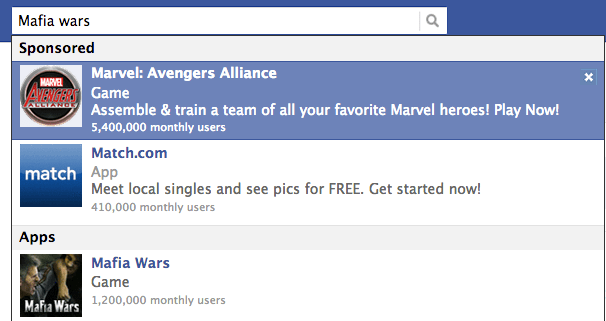
Facebook doesn’t have a full-fledged web search engine yet, but on August 22nd it officially launched its Sponsored Results ads for the site’s search typeahead. These let businesses pay to have their Page, app, or other Facebook property appear above organic results when users search for a specific property. For example, gaming company Playdom currently pays to show its game Marvel: Avengers Alliance at the top of typeahead results when people search for “Mafia Wars”, a game by its competitor Zynga.
Initially announced in the previous quarter, these last few months saw the rollout of the API for buying Sponsored Results, and the first reports of the performance. Optimal attained click through rates between 0.7% and 4.1%, well over 10x better than standard Facebook sidebar ads. Meanwhile Nanigans saw CTR exceed 3% in some campaigns, and found the ads could cost less than standard ads.
Sponsored Results are a powerful way for businesses to divert traffic to themselves and away from competitors, making them a lucrative buy in cut-throat industries. Their performance and advertiser interest bodes well for the money-making potential of a real Facebook web search engine — something CEO Mark Zuckerberg said is in the works and investors are salivating over. But for now, there may not be enough people searching in the typeahead for these to be hugely profitable.
Status: Sponsored Results can now be purchased through the Ads API and Power Editor, and are now appearing in the typeahead results of search for many popular apps and Pages. They may have already generated a little revenue, which could grow next quarter. More important, though, is how they foreshadowing a serious Facebook search ads business — a completely new monetization channel.

IT’S GONNA GET WORSE BEFORE IT GETS BETTER

Until these products gain traction, Facebook’s earnings may not be too impressive. And next month, nearly 1.2 billion additional shares will become eligible for sale by employees and investors when a big part of the company’s stock lock-up expires on November 16th. That means the share price is likely to dip lower.
$FB may rise again once this major post-lockup flood subsides and these new money-makers kick in, but at least until then Facebook will need to sell Wall Street on the future, not the present. It has to communicate that the evolution of advertising and commerce depend on the data only Facebook has.

Enhanced by Zemanta
Tags: Facebook, Starbucks, Wall Street, FBX, Facebook Gifts, Facebook features, Mobile code, Mobile payment

5 Big Data News You Should Know Today - 23 October 2012

1) Data Is the New Supply Chain: Learn the Current Methods, Risk Management

DAMA International, the global association of professionals in data management, states that “Data Resource Management is the development and execution of architectures, policies, practices and procedures that properly manage the full data lifecycle needs of an enterprise.” In today’s information driven world, the data needs of an enterprise are very important. Some enterprises are built around providing information to external customers, and others have information of value that is used only with internal customers. In either case, the way data is managed is of great importance. While traditionally an internal IT department is responsible for this data management, now there are enterprises looking at external vendors to provide this management via cloud computing.

Read More


2) Cloudyn Launches Free Tool For Making Sense of Amazon EC2 Reserved Instance Costs

Today cloud cost management company Cloudyn announced a new free service for calculating costs of Amazon EC2 Reserved Instances. Reserved Instances are sort of like cloud instances that you pay a retainer for: you pay an upfront fee, and can then pay a discounted rate if/when you use them.

Amazon offers Reserved Instances at different rates depending on term of commitment — either one, two or three years. Cloudyn’s Reserved Instance Calculator will use predictions based on usage patterns to recommend optimal purchases. Given that Amazon actually opened its own marketplace for unused Reserved Instances last month, it seems like a tool for planning these purchases could come in pretty handy.

Read More


3) Integration Cloud Services Brokerage: What it is. What it isn’t.

The intent of cloud computing is to extract technical complexity by offering computing as a service, thereby reducing IT costs and freeing IT staff to focus on achieving higher-level business objectives. For many firms, these objectives are increasingly centered on the extended enterprise and a valuable network of customers, suppliers, business partners and cloud providers.

However, using cloud services for both back-office systems and B2B processes requires a high level of coordination and integration due to the inherent interdependencies. It’s one thing for these different services to exist as independent islands that never need to interconnect, or as loosely connected point-to-point interfaces. That’s easy to do. It’s another thing to outsource interdependent business processes to multiple cloud service providers. This becomes very complex, very quickly, and can mean adding staff and resources — whether it’s for writing code or just managing the integration process — either of which can negate many of the cloud computing benefits.

Read More


4) Big Data Case Study: Predicting the Weather with 3TIER

Where would you build a wind-farm? Somewhere windy, obviously. But how would you know how windy that area was a year ago, two years ago, three? How would you know when the windiest time of year was? How would you predict the weather for today, the weather for tomorrow, the weather for next year and beyond? The answer: talk to 3TIER.

3TIER, an industry leading company dealing in renewables risk management, helps businesses decide where to place their wind-farms, solar-farms and hydro-dams by giving them all the information they need to assess the future energy potential of any location. How do they do this? Big data.

Read More


5) Report: Wal-Mart’s Big Data Moves Will Boost Rackspace

Last week while the OpenStack conference was taking place in San Diego William Blair analyst Jim Breen reported that event organizer Rackspace (RAX) will likely win more business from retail giant Wal-Mart (WMT).

Breen noted that Wal-Mart was actively recruiting OpenStack engineers and the fact that Rackspace can gain traction with Wal-Mart for big data analytics reflects the progress of the OpenStack platform. Rackspace and Wal-Mart share a common enemy with Amazon.  Wal-mart has opened an office in San Bruno, California office to house @WalmartLabs, an innovation outpost that the brick-and-mortar company hopes will expand its Internet retail business and play ecommerce catchup with Amazon.  @WalmartLabs is in the process of consolidating its data analytics systems from EMC and IBM technology into a single global platform.

Read More

Category: Big Data News

Tags: OpenStack, IBM, Wal-Mart, Big data, Cloud computing, Amazon, Rackspace, Walmart

Enhanced by Zemanta

5 Big Data Quotes of the Week


Predictive analytics can figure out how to land on Mars, but not who will buy a Mars bar…. You should expect big data to have big impact. And you can bet that it will help machines interact more usefully with our unstructured, changing, and sometimes downright confused human ways. But if you’re counting on it to make people much more predictable, you’re expecting too much”–Gregory Piatetsky-Shapiro

“’Forming a data team is kind of like planning a heist’ [said Hunch.com’s co-founder Matt Gattis]. He meant that you need people with all sorts of skills, and that one person probably can’t do everything by herself. Think Ocean’s Eleven but sexier”–Cathy “Mathbabe” O’Neil

“The data warehouse architecture of the 1980s, to which I was a major contributor, of course, was based largely on the… single-version-of-the-truth simplification.  There’s little doubt it has served us well.  But, big data and other trends are forcing us to look again at the underlying assumptions.  And find them lacking”–Barry Devlin

“Security today is a real-time Big Data challenge”–Steven Mills, IBM

“…big data will once again become ‘just data’ by 2020 and architectural approaches, infrastructure and hardware/software that does not adapt to this ‘new normal’ will be retired. Organizations resisting this change will suffer severe economic impacts”–Gartner

Tags: Big data, IBM, Gartner, Matt Gattis, Barry Devlin, Cathy, Mars, Data warehouse
Enhanced by Zemanta

6 Practices to Implement Highly Efficient Data Centers


The world has become more cautious about saving the planet in the recent years and this has shown its impact on the data center operators who are now targeting on projects that boost the energy efficiency while taking in consideration its environmental impacts. Though these changes can be attributed to several attempts from organizations all around the globe defending the terminal impacts on the planet, such measures are being seen as a welcome change among the industry.

With Facebook announcing its environment friendly OpenCompute Project several other companies are now coming out of the dark and sharing information related to their data centers, the latest in this line being Google.

Research company 451 groups published a report on Highly Energy-Efficient Data Centers in Practice that shares six practices that are being adopted by organizations all across the globe to increase the efficiency of their data centers and reducing the operational costs while reducing the harmful effects that it may cause the planet to the minimum.


1. Holistic Approach:

While implementing improvements in the data centers the organizations need to take into consideration various technologies available and handle the project from various angles by taking note of different approaches. The green Grid has been implementing the same approach since the time it was founded.

This approach can be refined by encouraging collaborative approach between various departments and making sure that all the concerned people are on the same page regarding the processes involved in the data center improvements.

With Facebook’s Open Compute Project coming up, the collaboration will need to be extended outside of the organization as well.


2. Smarter Cooling:

The older ways of cooling that made the data center resemble a meat locker have changed now. The organizations have understood that deploying these cooling methods is simply throwing away money. Thus adopting other cost saving methods does make sense. One among them is liquid cooling that comes from Green Revolution Cooling that employs a low cost dielectric fluid that has 1200 times heat retention capacity than air.


3. Generating Self-Power:

The major dent is caused to the maintenance bills by the power bills. And the companies have realized it. Microsoft, Google, Facebook , Yahoo etc have started generating their own energy from the renewable sources. Solar panel comes as a natural contender but Fujitsu’s latest technology using Hydrogen to generate power is also finding wide popularity.


4. Using DC Power:

The data center power conversion methodology is a long process spanned across various sections. The AC power is first converted into DC and then back to AC after which the UPSes distribute that power to respective servers. In this entire process, as much as 50-70 percent of electricity is lost during conversion. The only way to overcome this loss is by setting up DC based power distribution system. It reduces power bills and conversion losses but the only reason organizations have been hesitant in implementing a DC based environment is the huge initial investment. But this investment represents big returns in a longer run.


5. Using IT Equipments Smartly:

There are various trends in the IT industry that have significantly affected the operations of the data centers. On the software’s side there is virtualization that has reduced the number of servers; also organizations these days are using data center infrastructure management software that helps them in positioning the physical and logical assets in a more efficient manner.

On the hardware front, organizations such as Google and Facebook have instigated new trends that have proved significant in the field of data center implementation. They have not only helped in reducing costs but have also declined the power wastage.


6. Adopting a Modular Approach:

The process of deploying a new data center takes a lot of efforts and the most critical aspect of any such successful deployment is proper collaboration between different teams working on the project. Not following these aspects will only lead to wastage of efforts in terms of size, density and redundancy. An approach that includes an improper collaborative environment often leads to such troubles. To overcome these problems the organizations are now implementing a modular approach that divides the project in different modules and proceeds accordingly. This also helps them to add or deduct a module according to the current needs of the project.

Tags: Google, Data center, Facebook, Microsoft, Efficient energy use, Direct current, Holism, Green Grid

Enhanced by Zemanta

5 Big Data News You Should Know Today - 22 October 2012


1) Why VCs Will Continue To Invest In Big Data Startups For Many Years To Come

This week, Splice Machine raised $4 million to develop its SQL Engine for big data apps. MongoHQ raised $6 million for its database as a service. A third startup, Bloomreach, announced $25 million in funding for its big data applications.

These three companies provide examples for why the investor community will continue to invest in big data startups for many years to come. All reflect a changing dynamic — the rise of the big data app and the need for a new data infrastructure. These two converging trends now drive funding for a widening number of startups that make data functional inside and outside the enterprise.

Read More


2) Gartner, IBM See Big Market for Big Data

Big data is becoming big business, and is a big trending topic in 2012.  This week Gartner and IBM release reports studying the true impact and direction of the big data market, while Teradata launched a big data analytics appliance.

Gartner says big data to reach $34 billion.  As a prelude to the Gartner Symposium/ITxpo 2012 it reported that big data will drive $28 billion of worldwide IT spending in 2012, and is forecast to drive $34 billion in 2013 spending.

Read More


3) Will Big Data decide the election?

FORTUNE -- There's a powerful vignette in Sasha Issenberg's The Victory Lab in which political consultant Alexander Gage presents his new data targeting system to Mitt Romney's 2002 gubernatorial campaign.

Gage has combined consumer records with political voting history to identify potential Romney supporters among nontraditional Republican voting blocks. Gage sees his work as revolutionary -- a first in politics, and potentially a first anywhere. Yet just as he completes his presentation, Romney's deputy campaign manager Alex Dunn raises his hand and deadpans, "You mean you don't do this in politics."

Read More


4) Is More Big Data a Blessing or a Curse for These Giants?

In today's segment, Fool.com analyst Austin Smith interviews acclaimed author and New York Times columnist Charles Duhigg about his recent book The Power of Habit and the iEconomy series he's written for the Times.

Today, Charles looks at whether more big data will help or hurt the companies that have already mastered the art of studying consumer spending habits. Companies such as Wal-Mart and Target have had an edge over other retailers for years with their mountains of data, but with Big Data overflowing now, will that advantage evaporate?

Read More


5) Sharing data a big complicated step for health care system

To those in fully automated industries, like banking, the state's rollout of a new health information network last week must seem sadly behind the times.

Massachusetts officials declared the Health Information Exchange open for business Tuesday by sending Gov. Deval Patrick's medical data from a hospital in Boston to a trauma center in Springfield. The electronic information traveled halfway across the state and, just as importantly, crossed tricky medical provider boundaries.

Read More

Category: Big Data News

Tags: Technology,Business,Big data,big data market,big data apps,big data applications,big data startups,Big Data,Read,new data infrastructure,Gartner,big data analytics appliance,Big Data News,three companies,big trending topic,big complicated step,hand,Wal-Mart,business,new health information network,Target

5 Big Data News You Should Know Today - 20 October 2012


1.  Big Brother meets Big Data: Governments start scrutinizing credit card records

The economy is so bad in Argentina that the government recently said it would start taxing overseas credit card purchases. It also demanded that banks report all credit card transactions -- foreign or domestic -- saying the data would be used to find tax cheats.

Even George Orwell couldn't have imagined this meeting of Big Brother and Big Data: a handy database of every single purchase made by citizens, ready to becategorized and analyzed by the government. Let your mind wander for a moment and you can imagine the disturbing possibilities of a government so invasive that it knows when and where you buy milk and bread.

Read More


With all the talk of “Big” data from vendors and their sale forces, consultants excited by new opportunities and business people grappling with whether or not their revenue will go up, it is vital to understand the “Big” picture and the best way to do this is see where architecturally everything fits together.

Getting an understanding of the integrated architecture of Big Data is vital if any organisation is to understand how much of their current investment in their information environments including items like hardware, software tools and people’s skill sets can stay, need to be replaced or be upgraded.


3. Batten down the analysts, it’s a big data-BI storm

Hadoop is getting closer to business intelligence thanks to a slew of new products ranging from a SQL database built atop Hadoop to an appliance packaging the two alongside a full complement of servers. On Wednesday, Birst, Teradata and Splice Machine got into the act.

Read More


Most big data initiatives currently being deployed by organizations are aimed at enhancing customer experience, said a report byIBM and Said Business School at the University of Oxford. Despite a strong focus on customers, less than half of the organizations engaged in big data are currently collecting and analyzing external sources of data.

Social media and other external data are being underutilized due to the skills gap.Having advanced capabilities requires analyzing unstructured data - which includes geospatial data, voice, images and video - as well as streaming data remains a major challenge for most organizations. Less than 25% of the survey respondents say they have the required capabilities to analyze highly unstructured data - a major inhibitor to getting the most value from big data. Organizations need to embrace and manage data uncertainty and determine how to use it to their advantage.

Read More


While Big Data has evolved into one of 2012's most buzz-worthy topics, one of the next big buzz topics -- machine-to-machine (M2M) communications or "the Internet of Things" -- is actually going to make Big Data even more powerful.

Read More


5 Big Data News You Should Know Today - 19 October 2012

Introducing from today, 5 Big Data news of the day.

1. IBM Takes a Big Data Approach to Security


Companies will spend an estimated $50 billion on computer security this year, but they are not feeling particularly secure these days.

Blame innovation, if you like. Every big digital advance opens the door to both opportunity and mischief. Smartphones, cloud computing and the data explosion promise a revolution in communications, cost-savings and knowledge discovery. But those three trends in technology also create security headaches.


Read More


2. Big Data Hype (and Reality)


The potential of "big data" has been receiving tremendous attention lately, and not just on HBR's site. With interest in the topic growing exponentially, it has been the focus of countless articles and perhaps too many meetings and conferences.

But to the extent that big data will have big impact, it might not be in the classic territory addressed by analytics. Most applications of data mining and analysis have been, at their hearts, attempts to get better at prediction. Decision-makers want to understand the patterns in the past and present in order to anticipate what is most likely to happen in the future. As big data offers unprecedented awareness of phenomena — particularly of consumers' actions and attitudes — will we see much improvement on the predictions of previous-generation methods? Let's look at the evidence so far, in three areas where better prediction of consumer behavior would clearly be valuable.

Read More


3. Twitter: The human face of big data

Every day, Twitter users send 400 million Tweets expressing a vast array of ideas and opinions. Collectively, and studied in aggregate, public Tweets are not only measurable. They can reveal any number of clues and trends about who we are: our cultures, our mindsets, who we favor or disfavor, and much more.

For instance, analyzing billions of Tweets helped two researchers unlock new insightsabout public health issues and the way disease is spread.

Read More


4. BloomReach nets $25M to turn big data into marketing gold

BloomReach raked in $25 million in new venture funding in a C Series round led by New Enterprise Associates, bringing total venture funding to a healthy $41 million. The be-all-and-end-all for BloomReach, which emerged from stealth in February, is to help online retailers make the stuff they sell more easily found by would-be buyers so they’ll actually sell more of it.

As BloomReach CEO Raj De Datta told my colleague Derrick Harris early this year, companies don’t know how to show off their product catalogs in a way that best aligns with how customers search. Less than a quarter of web pages get any traffic from natural or paid search in a given month – a problem that will only get worse as the amount of online data grows. Their products are needles in an ever-expanding haystack. But if they know how people are searching for things and learn how to display their content better to suit that behavior, they can boost discoverability and thus sales.

“Understanding relevance of content to the way people express themselves turns out to be a difficult problem,” De Datta told Harris.

Read More


5. Big Data to drive $28bn of IT spending: Gartner

The figure is expected to increase to $34bn by 2013.

The rise in businesses dealing with more information will see Big Bata contribute $28bn to global IT spending in 2012, according to a new report from Gartner.
Gartner revealed that the figure is expected to increase to $34bn by 2013, with 10% of new spending each year swayed by investment in big data, when compared to storage software, database management system, data integration/quality, business intelligence or supply chain management (SCM).
Currently, most Big Data spending is used on deploying traditional solutions to the Big Data demands, including machine data, social data, widely varied data and unpredictable velocity.
The research firm also revealed that the demands for new Big Data functionality in 2012 will directly drive only about $4.3bn of sales of software.

Read More


5 Ways to Make Web Analytics Data More Insightful

Fortune 500 companies can expect to push more than a gigabyte a day in raw web analytics data, which can be easily tripled for media companies. Big data is anything anyone ever talks about anymore, so the C-suite has never been more interested in integrated analytics, shining a spotlight on the web analyst team to deliver more than just pretty charts and high-level talking points.

Pulling the information from web analytics software should be less than 10 percent of the work, with an overwhelming 90 percent of time dedicated to deriving insights your organization can use to drive change.

So how to you go from pulling numbers to authoring insights?

1. Compare Trends, Not Just Differences

Web analytics software makes it extremely easy to compare equal periods of adjacent data, such as month-over-month or year-over-year, but other logical comparisons such as average weekday, current day versus the same day last week and other options are much more difficult to configure.

Unfortunately, the best way to find meaning in trends is by exporting data into Excel and crunching these numbers manually or by using pivot tables. You can then add layers of additional analysis such as calculating the long term mean, variance, and standard deviation.

2. Analyze the Significance of Your Data Before Drawing Conclusions

Nothing is worse than a web analyst that “cries wolf” over every little hiccup in a conversion rate. I once had a colleague that was very worried about a campaign’s performance, which dropped off sharply 8 weeks after launch, only later to learn that it was a back-to-school campaign and we were approaching Thanksgiving.

As discussed in the previous tip, calculating standard deviation is an easy way to determine whether the change you see in absolute numbers is statistically significant, if your data falls outside of two standard deviations of the mean.

3. Dig Deeper With Segmentation

Deciding on a driving force for statistically significant change is where you’re likely to spend 90 percent of your time in formulating insights.

Sometimes the driving force behind observed changes can be painfully obvious, such as broken functionality on a website, but other times a change can be like searching for a needle in a haystack. By segmenting your analytics data, you can quickly find commonly-shared behavioural traits that are influencing the changes in trends observed.

4. Correlate Reported Trends With Business Impact

This is the part of the report that should answer: why do I care? As a simple rule of thumb, try to attribute fair assumptions in revenue generation, cost savings, or visitor satisfaction back to the trends you observe.

For instance, did the landing page for a seasonal campaign perform significantly better last year? If so, how quickly could a change be made and what is the overall effect the change would make on bottom-line sales dollars?

5. Make Insights Actionable

The easiest way to make insights actionable is to derive ideas for a complementary optimization program. While there are many places to start optimizing, the goal for your web analytics reports is to include insights that can actually be completed within a short amount of time and have a significant impact.

It neither make sense to test modifications to pages with less than 1 percent of your overall site’s traffic, nor does it make any sense to recommend changes to pages beyond your organization’s control.

How do you make your web analytics reporting more insightful? Share your comments and ideas below!

Want to Know the Hottest Digital Marketing Strategies for 2013?

Join hundreds of digital marketers and experts at SES Chicago, November 12-16. SAVE $400 on an All Access Pass now through October 26. Register today!

Get inspired with a Keynote from Avinash Kaushik, Google's Digital Marketing Evangelist
Connect, share and get an in-depth education on SEO, PPC, social, analytics, mobile, and much more from the industry's leading practitioners

Explore evolving trends, opportunities and evolving technologies in digital marketing

There's still time to exhibit at SES Chicago. More than 80% of attendees play a key role in recommending and approving product and service purchases. Learn More.

10 Reasons SEO Is Harder for Small Businesses


SEO is harder for small businesses


“Why is SEO harder for small businesses?” This question has popped up a couple of times in our organic keyword referrers. We’ve been saying for months that SEO is getting harder, and that it’s especially difficult for SMBs to excel at. But why? Why is SEO easier for the big dogs? Make no mistake, it is – even if it’s getting harder for them too.

Here are 10 reasons why smaller businesses struggle to succeed at SEO.


1. You have less money.

This is the #1 reason SEO – and everything else! – is harder for small businesses. It’s an old saw but it’s true: You have to spend money to make money. The reason companies spend money on marketing and advertising is because they deliver ROI, but sometimes there’s a tipping point. For example we’ve seen small businesses that didn’t see ROI from PPC until they raised their daily spend, counter-intuitively. SEO is the same way. If you can devote more money to your search engine optimization efforts, you’ll see better returns. Bigger companies have bigger budgets they can allocate towards hiring more employees, bringing in top-notch consultants, investing in “big content” and great web design, and so on.

2. You have less time.

OK, I lied: This is tied for #1. Time is money, and if you have less money you also have less time. Fewer heads on the marketing team means that everyone is juggling multiple tasks and nobody can focus 100% of their time on SEO. Some businesses are so small they have just one or two people doing EVERYTHING, making SEO exponentially harder. Real SEO takes a lot of time. Creating worthwhile content, optimizing your web pages, promoting your assets and securing links, running A/B tests – none of this is easy. Small businesses end up doing a rush job or neglecting it altogether, resulting in underoptimized sites with poor rankings.

3. Something else always comes first.

When you’re short on resources, SEO-related tasks always seem to get pushed to the bottom of the list. Blogging and other forms of content creation are a prime example – everyone’s got the best of intentions, promises are made (“I’ll get you that blog post by the end of the week!”) but nothing ever really gets written and published. The fact is, if you wait to do SEO until everything else is done, you’ll never do any SEO. That’s why big companies hire a dedicated SEO – no excuses.

4. It’s harder to keep up with changes.

Again, this is essentially a resource problem. An SEO specialist who lives and breathes search has time (and incentive) to follow industry publications and keep up with the rapidly changing search landscape. They’ll know if Google has released a big algorithm change or other significant update that could affect your rankings and strategy. They’ll hear about new techniques and be better able to judge what’s worth trying and what isn’t. SMB marketers are often too busy trying to keep up with their own industry vertical to spend any time following the twists and turns of SEO. Here at WordStream, we have an advantage because search marketing is what we do – we have to keep up with search. But what if you sell shoes or medical equipment? Your morning reading is going to look very different.

5. Google favors brands.

In SEO we love to whine that Google favors brands, but the truth is, everyonefavors brands. All other things being equal, Google ranks big brands higher in the search results because they have user behavior data indicating that people click more often on recognizable brand websites. So if you want to compete on a keyword that bigger brands are also going after, you’ll have to work that much harder to prove your content is relevant and worth the user’s time. For a lot of branded keywords, you’ll never be able to beat the bigger companies.

6. Bigger businesses have been at it longer.

Big businesses weren’t born that way – they started small and grew. So big companies have generally been around longer. If you’ve been operating as a small business, doing well but staying small, for many years, that’s great – you’ll have an advantage. But lots of small businesses haven’t been around that long, and it’s tougher for them to rank because their younger websites haven’t accrued authority and a great link profile yet. This is why it’s harder for new websites to rank on competitive keywords. Aside from the fact that Google likes older domains, big brands have simply been doing SEO longer, so they’ve more things and they know what works and what doesn’t. They can repeat past successes and repurpose their content assets, rather than starting from scratch all the time.

7. Your website is smaller.

If you’re a small business, chances are your site isn’t just newer, it’s smaller too. You have less content and fewer pages overall, which amounts to fewer keywords you can possibly target and fewer opportunities to rank. Really big websites get more traffic in part because the sea of search queries they have the potential to rank for is so much bigger. And big brands have bigger websites because (you guessed it) they have more resources to funnel toward creating content, and because they offer more products and services. Think of Amazon and all the individual pages they have for each and every product they offer!

8. You have fewer tools and less powerful software.

Your itsy-bitsy marketing budget rears its ugly head again. Enterprises can afford to invest in great software. The in-house SEO at a big company has tools at his disposal that automate away some of the time-consuming tasks involved with search marketing. They can afford to buy up for better analytics, better keyword research, better reporting tools, better conversion optimization tools, etc., etc. Small companies are often stuck with free, which makes it harder to gain a competitive advantage. More manual work also takes more time.

9. You have less clout to leverage for link building and media coverage.

Big sites and brands with great reputations tend to get links without even trying. It also helps to have some weight behind your name when you actively reach out for links. If you’re trying to get media coverage in a big publication, it helps enormously if they’ve already heard of you. Barring that, it’s great to be able to say that your business has been mentioned in other notable venues – it’s like the Good Housekeeping seal of approval. But smaller businesses are less likely to have brand recognition on their side.

10. You don’t have a relationship with Google.

Bigger companies tend to have a personal relationship with Google. They may have a dedicated rep. If something goes south (“Holy crap, our rankings fell off a cliff overnight!!”) they can call their contact at Google for help. Small businesses will have a lot more trouble figuring out what to do. It’s a dirty little not-so-secret secret, perhaps – like the fact that it’s much easier to get into an Ivy League school if your family name is on one of the buildings – but big brands spend a lot of money on Google advertising (like $50 million a year). And that means they’ve got connections inside, and Google is invested in keeping them happy.
Is SEO Still Worth the Trouble? In a Word, Yes

Now listen: We’re not saying you should give up on SEO. In fact, you have to do at least the bare minimum SEO if you want to have a reasonably viable presence online. Basically, if you have a website, you want to accomplish three things:
Help potential customers find your site via search.
Make sure your site is easy to navigate once they’ve found it.
Make sure it’s obvious what they should do next, whether that’s calling in or adding something to a shopping cart – and convince them to do it.

These tasks, especially the second two, involve the principles of web design, usability, and conversion rate optimization as much as they do SEO. But to accomplish #1, you’re going to have to think about search engine optimization. Of course, you should have other sources of traffic for your site – PPC/remarketing, social media, email marketing, word of mouth – but if you neglect SEO, you’re leaving a great potential source of brand-new leads untapped.

The trick for small businesses is figuring out what you can accomplish given your limited resources. Also, remember that there may be ways that being small actually helps you! For example, small business are often more agile, and more willing to experiment. So stick with it, cover your basics first, make sure your managers know SEO is important, and investigate new opportunities as you can find the time.

Do you work at a small business? How do you deal with the challenges of SEO?


8 Startups On How They Knew They Had To Change Their Original Plan


There comes in a time the life of many startups when it starts to become clear that everything is not going according to plan. But how do entrepreneurs tell if they need to keep going all in on the original plan, or pivot to something new?
To find out how real-world companies deal with that decision, we asked eight successful young entrepreneurs from the Young Entrepreneur Council (YEC) when they realized they had to let go of the products, plans and strategies that they worked so hard to develop. The most common indicator? Customers made it clear they wanted something different.


1. As Soon As You Can

Smart companies almost always pivot, usually multiple times. You might change the product because it doesn't meet the needs of the market you identified. You might change the market you're targeting because another market finds the product more useful, will pay more money, or has a larger pool of prospects. You might change the revenue model to one more attractive to customers. One of your primary goals early on should be to find out which elements of your business model are flawed as quickly as possible, so you can correct the course with minimal wasted time and effort. The key to doing this is having data. Analytics, surveys, face-to-face interviews and more will help you make informed decisions and ensure any pivots you make get you closer to your goal. Sean JohnsonDigital Intent


2. Find New Goals You're Aligned With

It's quite the blow to the ego when you wake up one day and realize, "Wow... this isn't working, and it hasn't been working for a while." But the good news is, when you know something isn't working, deep down, you usually also know what would work better. It's just a matter of allowing yourself to "go there" and tune in to what feels out of alignment with who you are and your mission. The way I do this is by thinking back to a moment when I was working on something using one of my "old" models and feeling really frustrated and irritable. I think of the words that were forming in my head at that time (usually, it's something like, "If only I could ____ instead"). That's the clue that tells me what I should change. And voila: you've found your pivot point. Amanda AitkenThe Girl's Guide to Web Design


3. The Feedback-Induced Pivot

It is time to pivot when your customers are consistently giving you the same feedback that things would need to be different for them to purchase. It often takes six months to a year to determine whether or not you are on the right path. Too often, we see entrepreneurs pivot too early before they have talked to enough customers to constitute an adequate data sample. Eric CorlFundable LLC


4. Don't Throw Out Your Code!

Pivots are an evolution of your business, but it doesn't mean that you need to entirely let go. It can make your transition easier if you view the pivot as setting aside your previous hard work to pursue a strategy that will be stronger. Especially for technology entrepreneurs, I caution against scrapping and forgetting the code you and your team have worked hard to develop, because it's likely that, even post-pivot, you can adopt or adapt something from the early version of your product for the pivoted deliverables. Shelve your products and plans to pursue your pivot full-force, but don't let go of them completely. Doreen BlochPoshly Inc.


5. Your Customers Tell You What They Want

We started as a free-screenwriting-software company back in 2008. Our goal was to give away screenwriting software and convince producers they should buy screenplays from us. It wasn't until 2010, when Levi's came to us and said "Hey, you have a ton of writers on your screenwriting software platform (50,000 at the time), can they work on non-entertainment industry projects?" After we finished the project, we realized we were onto something, and more and more folks starting coming to us asking for help with blog posts, tweets and other written content - so we pivoted to Scripted. Our pivot was driven entirely by customer demand for our product. Sunil RajaramanScripted.com


6. You Need To Grow To Survive 

Pivoting is a big decision. The only time to consider pivoting your business is when a huge opportunity is in front of you. If you are going to make a major change to your organization, it's important to realize that this will affect everything else that goes on. Pivoting is not the way to fix smaller problems. The times when we've pivoted a business required looking at our entire operation and refocusing or even replacing sections. When we first launched Yodle, we intended the company to address all the Web services needs of small businesses. As we discovered what it would take to scale that business, we realized we should pivot and focus on just advertising and marketing. Ben RubensteinYodle


7. You Aren't In Love With The Future 

You're inevitably going to hit setbacks, so it's important to be motivated about reaching your destination. For that reason, you should pivot when you're not excited about the long-term direction you're heading in. Here's an example from my own business. I own a marketing company. And in the early days, we used to work only one-on-one with clients. When I looked into the future, I realized I would only be able to serve, at most, a couple dozen clients. I saw how this business model was limiting our growth and our overall impact, so we changed course. We pivoted to start offering self-service training in addition to one-on-one services. And we've been happier and more successful ever since. Pete KennedyMain Street ROI


8. Your Product Isn't Connecting

First and foremost, it's always smart to listen to your customers. Their feedback is priceless, and a majority of businesses pivot because either their product/service is not connecting, or they can't monetize it. When a majority of customers keep saying your product is overpriced, it's probably true. If you are a service-based company that founded its business model on retainers, switch to a pay-for-performance model. These little things end up making a big difference. Blake BeshoreTatroux 
The Young Entrepreneur Council (YEC) is an invite-only nonprofit organization comprised of the world's most promising young entrepreneurs. In partnership with Citi, the YEC recently launched #StartupLab, a free virtual mentorship program that helps millions of entrepreneurs start and grow businesses via live video chats, an expert content library and email lessons.

Enhanced by ZemantaTags: Entrepreneur, Sean Johnson, Business model, Customer, Business, Small Business, Start Up, Steve Blank